Balance, Theme and Variation, Accent, Cannon


 I

Unit: Elements of Dance

Theme: Balance, Theme and Variation, Accent, Cannon


Introduction 

Balance

 A dancer travels through space, turns on its own axis, elevates his/her body on his/her metatarsals, makes gestures, remain in stillness, uses all body parts, does floor-work and continuously transfers weight from one side of the body to the other. Achieving stillness while in balance is mostly appreciated when coming from a position of imbalance. Going from an off balance position to a position of balance and vice versa is the skill we are developing today.

Theme & Variation

 "Theme and variation" is a popular musical form in which a composer states a melody and then repeats it several times with changes to create more interest and variety. In dance, something similar happens. One can create a movement to then repeat it several times with changes in directions, levels, speed, etc, to create more interesting variations.

Accent

 An accent in dance is a movement or shape performed in such a way as to give emphasis.

Cannon

Canon is a choreographic form that reflects the musical or dance forms of the same name, in which individuals and groups perform the same movement/phrase beginning at different times. Although it is a choreographic form, we will address it here as a variation of a theme that can be repeated as a cannon.


 II

Learning Objectives


  • Understand balance, theme & variation, accent and cannon
  • Explain what the body has to do to achieve a position of balance to experience the rest of the concepts address today
  • Gain an awareness of body weight and its influence on achieving a position of balance to re-create the other concepts
  • Experience positions that help the dancer to achieve balance and expand into themes, variations of that theme, accents and cannons


Main Lesson

III


1

WarmUp

Stretching


2

 Concepts
 

Picture


 Balance

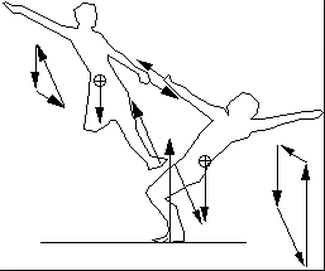
 Balance in dances means there is no force or torque supporting the dancer. In order to keep your balance, force is not needed because your momentum does not change and torque is not needed because your angular momentum does not change. 

Question 1

How would you explain balance from a dancer's point of view using your own body as a reference?


Balance is all about gravity and your center of gravity. In order to stay completely balanced your center of gravity must be directly above the area of contact you have with the floor. 

Question 2 

Place yourself in a balanced position and pay attention to your body's response. What needs to happen for your body to achieve balance?


That is why when you balance larger objects onto smaller objects, you tend to place that object in the middle so that it is equal on both sides meaning it is completely balanced. If you place one side of the larger object onto the small object, the larger object will fall showing that it is unbalanced.

Thus,  balance is keeping weight equal on all sides. 

Question 3

How is weight related to the achievement of balance when you use your own body to find a balanced shape?


Source:  https://thephysicsofdance.weebly.com/balancing.html

-----------------


3


 Question 4

What four yoga poses help us achieve balance?


 4

Theme and Variation

 
 Water Study, Doris Humphrey
 
Choreography is presented and then repeated with changes, while still retaining enough of the theme that the original movement is recognizable. The significance of the original theme increases as it’s examined in its variations. Any number of tactics may be applied to the main phrase to create a variation, including:
 
Altering the tempo, rhythm or direction in which the pattern is performed.
Applying another structural tactic to the movement, such as inversion.
Changing the style or mood.
Repeating or lengthening portions of the theme, while omitting others.
Modifying the number and placement of dancers.

Example: Taking a phrase, then trying it at twice the speed, or with only the arms, or completely in reverse, or as small as you can possibly move. With any theme, begin with simple steps, so there are plenty of variation options. 
 
 Question 5
 
What is the theme in the dance presented in the video above? Describe its variation....


5

 Accent


(min. 0:33)


 Question 6

Why is the accent an important element in a dance or movement piece?


6

Cannon 


Question 7

Write a reflection about canon as danced in the video.


Question 8

What is the difference between theme and variation and canon? 


----------------


IV

 A Note to Remember


Balance is always negotiated while we move. However, achieving balance while engaging in challenging positions is a skill dancers learn to conquer.

Theme and variation make the dancer aware of that one recurrent theme that permeates his/her dance.

Simultaneous canon - all the dancers start dancing at the same time but at a different point in the dance phrase. This adds depth to the dance. Cumulative canon - as before, the dancers all start at various points in the movement phrase but all finish at the same time.


V


Case Studies
 
Theme and Variation, Cannon, Accent
 
1

Masterpiece: Water Study, Doris Humphrey

Call and response is a physical conversation: One person/group performs, then another dances in response. This form has its roots in the songs, drums and dance of African culture, and is often seen today in hip hop and tap. Example: Two groups face each other onstage and perform alternating 8-counts. 
 

 Question 9
 
Write a reflection on the piece.
 
-----------------------------------------------

2


Masterpiece: Revelations, Alvin Ailey

Ground bass requires a single theme to be constantly reiterated throughout the composition, juxtaposed against other group movement. This theme may be the primary focus or serve as background movement. It may also be passed from one individual or group to another, or performed by the entire group in unison. Look for ground bass in Native American dances where the women provide a constant background theme and men execute difficult and varied dance steps as the principal center of interest. Example: At any given point during the dance, someone is repeating an 8-count arm phrase. 
 
Question 10
 
Compare and contrast Revelations and Water Study.
 
--------------------------------------

3


Masterpieces: Accumulation and If You Couldn’t See Me (an inversion of Accumulation), Trisha Brown

In music visualization, the structure of the dance mimics the structure of the music, whether dancers are representing specific instruments or dance phrases correspond with musical phrases. Example: Creating a petit allegro phrase that matches a speedy flute solo in the music, or returning to the same steps during each chorus of a song.
 
Question 11
 
In which way is theme and variation present in Brown's Accumulation?
 
--------------------------------
 
 
4


Masterpiece: L’Allegro, il Penseroso ed il Moderato, Mark Morris
 
Question 12
 
How is Mark Morri's piece an example of theme and variation? 
 
 
Accent


 Cannon


Question 13

How does canon enrich the choreography of a dance piece?


VI


Activities


1

Balance


Students will experience alignment and balance through a yoga session & movement explorations.

They will choose 8 moves that require balance and create a phrase.


Theme and Variation

 Create a movement phrase with 8 moves and turn it into a second phrase by changing levels, speed, directions and size.


Accent
 
Students will recreate the slow/fast motion already experience in class to add an accent to their solos.

Cannon

Students will find a phrase or movement within their ensemble's choreography that they would like to turn into a cannon phrase.

2


Students' ensembles will add a canon phrase to their existing choreography.

Students will add a balanced pose, a theme and variation phrase and an accent to their solo phrase.


--------------------------
 
 
VII
Journaling
 
 
 VIII
Glossary


IX
Sources  
 
https://www.dancespirit.com/how-to-structure-a-dance2326035194.html

Elements of Dance. https://www.turton.uk.com/wp-content/uploads/sites/2/2020/02/Dance-Key-Words.pdf

Dance Glossary. KET Education. https://education.ket.org/resources/dance-glossary/


X

 Students' Work

 Students making up will record a phrase in which they integrate the concepts discussed in today's class and post it on Discussion Board. 

18 hours ago
Nicholas Finley
3/21 

1. How would you explain balance from a dancer's point of view using your own body as a reference?
    -  Balance as it pertains to dancers is when the body as a system is arranged in such a way that the forces acting on it sum to zero.


2. Place yourself in a balanced position and pay attention to your body's response. What needs to happen for your body to achieve balance?
    - When I stand on one foot, I need to activate my core to stabilize my torso, and I can feel my standing foot making many micro-adjustments. Additionally, I shift my weight so that I'm more centered over my standing foot. 


3. How is weight related to the achievement of balance when you use your own body to find a balanced shape?
    -  Weight must be relatively evenly distributed about the point of balance. 


4. What four yoga poses help us achieve balance?
    - Tree, knee lift, warrior 3, half moon, and side plank. 


5. What is the theme in the dance presented in the video above? Describe its variation....
    - I would call the theme a rising, spiraling motion. First it is grown from a subtle motion into a more dramatic wave across the entire group. Then when the group splits, the movement is expounded upon - inverting the direction (high to low), including a dramatic element of clashing, different parts of the spiral being explored (left to right, up and down) across greater distances, more full-body incorporation. 


6. Why is the accent an important element in a dance or movement piece?
    - It is an obvious point of interest or attraction for the viewer, and can be used to draw their attention to important aspects of the dance, or give dynamic contour.


7. Write a reflection about canon as danced in the video.
    -  Canon is a neat additive process. It gets big results for a relatively small compositional input. 


8. What is the difference between _theme and variation_ and canon?
    -  Canon does not seem to involve altering or deviating from the movement pattern, only starting it from different points or at different times. Theme and variation involves more transformation. 


9. Write a reflection on the piece. (Revelations)
    - This was a very unique experience for me, and very affecting. I'm not even sure how to process a piece of this scale. 


10. Compare and contrast Revelations and Water Study.
    - Water study felt less emotional/human than Revelations. It was like looking at a landscape painting versus a Renaissance fresco. Obviously they differ in scale and subject matter, but they both utilized theme and variation to create and sustain interest. 


11. In which way is theme and variation present in Brown's Accumulation?
    - The basic patterns are added to over time. 


12. How is Mark Morris' piece an example of theme and variation?
    - (The provided video doesn't have much dancing in it, and I couldn't find a good recording on my own)


13. How does canon enrich the choreography of a dance piece?
    -  It's like adding delay or reverb to a musical recording, it adds depth or resonance or duration to what might otherwise be a very perfunctory movement.


Comments

Popular posts from this blog

Constructure, Structure, Substructure / Frame, Portraiture, Score

Elements of Dance: Shapes & the Hidden Dimension

Laban's 4 Movement Components & 8 Efforts