Body Releationships
REVIEW
Extra Daily Techniques
Laban Choreutics
geometric scales
sacred geometry
I
Unit: Relationships
Theme: Body Relationships
Introduction
Relationships are the way in which dancers move with other dancers eg lead and follow, mirroring,
action and reaction, accumulation, complement and contrast,
counterpoint, contact, formation. There are also relationships between
one's own body parts that can be explored.
II
Learning Objectives
Explain the relationship between dance terms when creating dance
Explain the relationships between body parts
Gain an awareness of movement focused on body parts
Experience the creation of a solo phrase where body parts are the main motivation
III
Main Lesson
1
Warm Up
Stretch
2
A
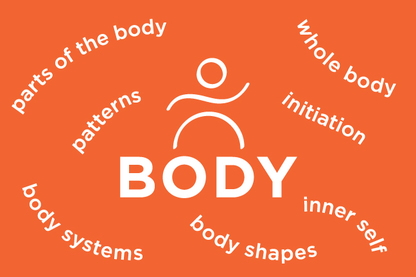
Category Body includes:
Body Parts
Patterns
Whole Body
Initiation
Body Shapes
Body Systems
Inner Self
B
The body
category describes structural and physical characteristics of the human
body while moving. This category is responsible for describing which body parts are moving, which parts are connected, which parts are influenced by others, and general statements about body organization.
Initiation of movement starting from specific bodies;
Connection of different bodies to each other;
Sequencing of movement between parts of the body;
Patterns of body organization and connectivity
Question 1
Explain in your own words the relationship between the terms listed above in section A when creating dance?
3
Video
Chicago Dance Studio
Building relationships with your body through dance, movement and exploration is the topic for Victoria Bradford and members of the Chicago Dance Studio "A House Unbuilt." Get out of your seat and get a preview of an ambitious social performance art piece scheduled to run the entire length of the Mississippi River in 2019! Victoria Bradford is Executive & Artistic Director of movement research company A House Unbuilt. She has produced works of social practice, public art, performance, and installation for the Museum of Contemporary Art Chicago, McColl Center for Art + Innovation, and deCordova Sculpture Park and Museum, among many other spaces. Victoria has built collaborative projects rooted in site-based, response-driven practices. Her current work Relay of Voices: The Great River Run involves collaboration with 104 towns and cities along the Mississippi River, tying back to her origins in Coastal Louisiana and the environmental, political, and cultural dialogue specific to that region and places like it. A House Unbuilt dancers for TEDxQuincy include Angela Gronroos, Lisa Leszczewicz, Carla Gruby, Zack Bailey, and Ben Sanders.
Question 2
What do you think about the relationships established in this video between ideas and body parts?
4
Relationships
body parts to body parts
body parts to objects
individuals to groups
individuals to groups and objects
individuals and groups to the room/space
IV
A Note to Remember
There are relationships between one's own body parts that can be explored through dance and movement.
V
Case Study
Video
In this video (2016) Chelsea Vargas was working towards a Bachelor of Arts in dance
education with a studio teaching concentration at Montclair State University, New Jersey. This study shows how she engages different body parts as she moves.
Study 1 - Body Parts
Question 3
Write your reflection on Chelsea Vargas' Study 1 in terms of body parts and their relationships. (See Case Study)
VI
Discussion Questions
1. Explain in your own words the relationship between these terms when creating dance?
2. What do you think about the relationships established in the piece by Chicago Dance Studio (See the video above) between ideas and body parts?
3. Write your reflection on Chelsea Vargas' Study 1. (See Case Study)
VII
Activities
1
Activity 1
Students explore movement that illustrates the different relationships listed bellow.
body parts to body parts
body parts to objects
individuals to groups
individuals to groups and objects
individuals and groups to the room/space
2
Activity 2
Students explore movement that illustrates the different relationships listed bellow.
mirroring
shadowing
meeting
parting
above
below
under
over
alone
connected
SOURCE:
3
Activity 3
Students combine all the patterns of body connectivity explained in each video to create a solo phrase using the explorations experienced during class.
VIII
Journaling
IX
Glossary
X
Sources
Student Artist Profile: Chelsea Vargas. https://themontclarion.org/entertainment/student-artist-profile-chelsea-vargas/
XI
Students' Work


Comments
Post a Comment